|
| Thursday, June 12, 2008 |
| TASK party venue change |

Please note: TASK is moving from the Regent Park ice rink to the Regent Park baseball diamond (not moving very far, but an important distinction nonetheless). The time remains the same: 3:00 - 7:00 PM, Saturday June 14.
The field is between Dundas St. East and Gerrard St. East (going East-West) and between Sackville St. and Sumach St. (going North-South). The best place to start is at Regent Park Focus (600 Dundas St. East). Go there and you'll see us on the field.
See you Saturday! |
posted by Luminato, Toronto Festival of Arts & Creativity @ 6:04 AM  |
|
|
|
| Sunday, June 8, 2008 |
| Exclusive Regent TASK trailer and Oliver Herring video stills |
We are thrilled to have internationally-renowned sculptor, photographer, video and performance artist Oliver Herring as a part of StreetScape's transformation of Regent Park. In the spirit of Living Space @ Regent Park's focus on artist/community collaboration, both aspects of Herring's participation in this project are the result of his newfound friendships with young members of the community.
Herring is a master at producing visceral and poetic video work that features improvised, on-the-street performances from non-actors. His latest video, "Make Believe In Regent Park," features performances from local youth, and will have its premier from June 13-15 as part of Living Space @ Regent Park. Below are some exclusive frames from the video:

Oliver Herring is also hosting a TASK party (the first Canadian TASK, in fact), to be held at the Regent Park Ice Rink on June 14, from 3:00 - 7:00 PM. A beautiful hybrid of performance art and communal celebration, TASK creates moments of chaos and utopia as participants use props, creative supplies, cooperation and imagination to interpret and perform randomly-assigned, user-generated tasks.
The rules are deceptively simple...
1) Write down a task (anything your imagination permits), and place it in the central task pool 2) Take a different written task from the pool 3) Interpret and perform your task 4) Repeat
... but the results are nothing less than wild. From building a lunar fort from aluminum foil to performing a marriage for two total strangers, only your imagination limits the possibilities of TASK. The event is free and open to absolutely everyone, so please come join us at what will be the exclamation point on an incredible weekend of arts programming at Regent Park. Check out this exclusive trailer for Regent TASK, the first of several:
For more information about Oliver Herring, click here to visit the site of PBS's prestigious Art:21 documentary series--they have featured Oliver's work and host a wealth of information about his various art practices. Of particular interest are two interviews that explore the nature of his video and performance work:
For StreetScape hours and locations, visit our home at Luminato here, and be sure to check out the Regent TASK blog for up-to-the-minute information about TASK. |
| posted by Luminato, Toronto Festival of Arts & Creativity @ 11:11 AM |
|
|
|
|
| Living Space @ Regent Park comes alive through workshops |
| Probably the coolest part (although there's considerable competition) about the Luminato StreetScape's Living Space @ Regent Park project is the fact that every single aspect of the exhibition is the result of collaboration between young members of the community, local and international artists, and dedicated outreach and education organizations like Pathways to Education and Regent Park Focus.
For months leading up to the festival, weekly workshops and artist mentorships have allowed for reflection on the history of Regent Park and the assimilation of personal histories into that narrative, given local youth concrete instruction in methods of artistic production, and--most importantly--forged new friendships and strengthened existing ones in a truly communal creative effort. Living Space @ Regent Park would not be a reality were it not for the enthusiasm of our young volunteers, the generosity of our contributing artists, and the organizational know-how of Pathways, Focus and Manifesto.
Below are documents of this process. Be sure to check out the fruits of our efforts from June 13-15, when Regent Park's transformation into a dynamic art environment is complete. See Luminato's StreetScape page for more details, hours and locations.
Deyvi and Luipa work on plotting their stories on maps of Regent Park at the Art Gallery of Ontario:
Internationally-renowned, NYC-based photographer Jamel Shabazz photographs Izzy for the poster project:
Jamel Shabazz and Hightop Studio lead a photo workshop:
Syrus Ware of the A.G.O. Education Dept. leads a storytelling and art interpretation workshop:
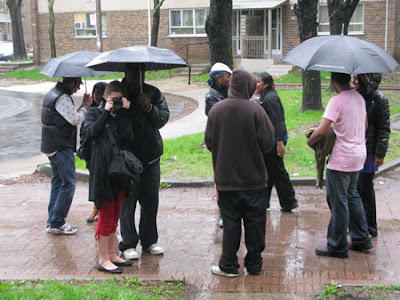
The downpour on the photo day helped unite the group and give the expo its motif: the umbrella.
Izzy with his poster:
The photo posters are unfurled with great excitement at Regent Park Focus.
Dan Bergeron (see a post on his work below) help mount Izzy's poster:
Izzy with his mounted wheatpaste poster portrait:
Luipa with her poster:
Fathima and Dan Bergeron mount her poster:
... as does Diana.
Scott Harber tosses a fresh can of paint to Patrick Thompson of them.ca while working on their participative mural/installation at Regent Park: Labels: http://bp0.blogger.com/_XsdXtsow2AQ/SEwQPevF-WI/AAAAAAAAAGk/MOkgL3pnaF0/s400/IMG_1596.jpg |
| posted by Luminato, Toronto Festival of Arts & Creativity @ 9:55 AM |
|
|
|
| Friday, June 6, 2008 |
| Jesse Bransford's 43.646944°, -79.378611° Opens at Brookfield Place |

After months of planning, weeks of fabrication and painting off-site, and one all-night build-a-thon, Jesse Bransford's spectacular installation has opened in Sam Pollack Square at Brookfield Place (map).
Very few works of art would benefit in juxtaposition with Santiago Calatrava's lofty architecture, but to his great credit Bransford's work looks like it was meant to be there. It will only be up through June 15, however, so don't miss your chance to see it--and in fact, interact with it--in person.
Drawing on the iconographic history of cartography and satellite imagery, among many other reference points, Bransford's work functions as both a beautiful object and mysterious cipher--a high-concept approach to StreetScape's exploration of art that engages with the urban geography. The palpable sense of mystery surrounding this installation is for good reason--there is much more to 43.646944°, -79.378611° than meets the eye. Suffice it to say that viewers who pursue the meaning behind Bransford's symbols will no doubt find the experience--quite literally-- rewarding... but we have probably already revealed too much. Perhaps we should let the artist himself provide some explanation:
"Most architecture is taken for granted - we have been living in modified spaces for so long that we rarely question the conventions of
the spaces we make for ourselves - we forget that these spaces are
built by people. Every time I make a new piece I have to remember this
again and again.
That said, I think there has been a radical shift in the last 20 years
in how we conceive space. Not that the spaces we move through have
changed so much, but that we have changed, our experience of space has
changed and the tools and interfaces have changed.
I am of course going to invoke virtual spaces and the ever growing
presence of these virtualized spaces in our consciousness. If you
haven't looked at your home address in google maps or an equivalent
service yet, I highly recommend it. Seeing your home or apartment
building zoom into focus from a larger perspective recalls the
prophesy of a global consciousness or awareness of the world as a
finite structure first spoken of in the 60's when we first saw the
Earth from space. These visualizations at our fingertips are becoming
structures that we use to navigate in real space. Maps are literally
overlaid upon our real space and become an interface just as 'real' as
what we see with our own eyes. Indeed, I find myself relying more on
the maps of spaces I interact with than the signs and signals the
streets give me.
Something that comes into sharp focus when I think about these ideas
is what, after all the hi resolution images and maps, remains hidden.
You as a viewer, though implied in every event you attend, are the
intangible. I suppose that is why I have sought to link the mysteries
of the work I've made for the festival specifically to the viewer.
This piece is even less than half a work without you. If you're
standing in the piece, you are at the Global Positioning System
coordinates 43.646944°, -79.378611°. The 'art' of this piece is more
in what you do with what has been given, and how you react to what is
not given."


 |
| posted by Luminato, Toronto Festival of Arts & Creativity @ 4:19 PM |
|
|
|
|
| Dan Bergeron goes big in Regent Park |
Dan Bergeron of Fauxreel Studios has been a massive presence in the Toronto street art scene for a while, and he's lent his talents to StreetScape's Living Space @ Regent Park project to brilliant effect. His giant wheatpased poster portraits of Regent Park residents are going up right and left, putting a human face on the architecture of Canada's oldest social housing project. This is just a small taste of what's to come when Living Space @ Regent Park opens (June 13-15--mark your calendars!), but already the most prominent street art blog in the world, Wooster Collective, has taken notice.
Check out the first few....
Cody (the poster and the young man himself): 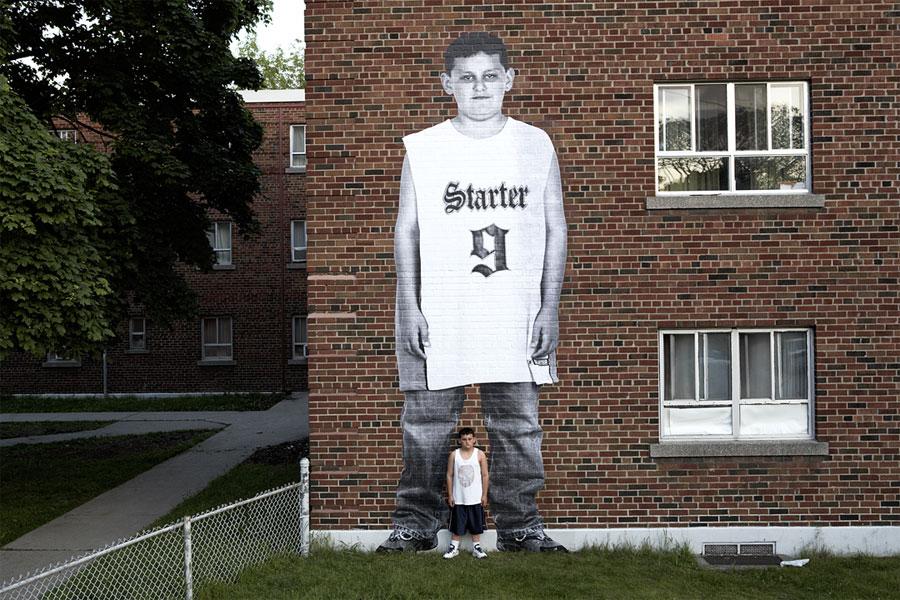
Fathima:
Windy:
Inez, in progress (Dan is the man in green): 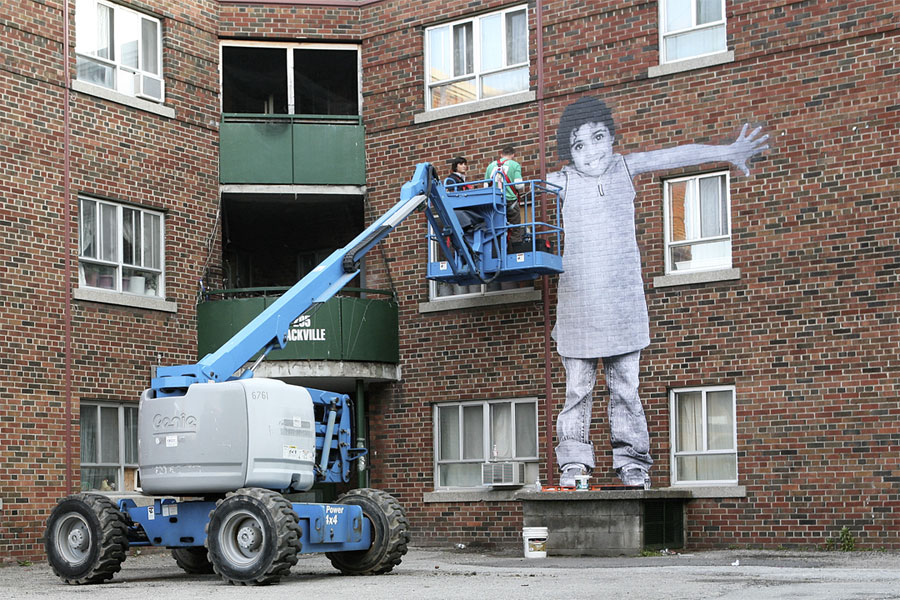
Beautiful as these photos are, they hardly do the work justice--you must go check these out for yourself. For more information about hours, locations, and other StreetScape projects, head on over to StreetScape's main page. |
| posted by Luminato, Toronto Festival of Arts & Creativity @ 7:18 AM |
|
|
|
| Monday, May 12, 2008 |
| StreetScape at Regent Park Workshop with Jamel Shabazz |
On May 3rd 2008, internationally acclaimed photographer Jamel Shabazz joined twenty youth from the Toronto community of Regent Park for a workshop in preparation for Luminato’s StreetScape installations. Jamel is an inspiring presence, equally known for his street photography as for his warmth, sense of humour and creative empathy for growing-up in the inner city.
Created with Admarket's flickrSLiDR.
The session was part of an ongoing eight-week series of workshops and mentorship sessions where youth participants are given the opportunity to learn about art interpretation and narrative in preparation for becoming Luminato Streetscape tour guides. In concert, the youth participation feeds creative input into the artwork that will be on display in Regent Park as part of Luminato’s StreetScape exhibition (June 13-15). For example, at the Regent Park installation site during the closing weekend of the festival, select photographs from the May 3 Jamel Shabazz session will be turned into massive projections as well as painted into murals during later sessions. |
| posted by Luminato, Toronto Festival of Arts & Creativity @ 10:14 AM |
|
|
|
| Thursday, April 10, 2008 |
| Art in The Public Space |
| Welcome back to the exploration of Luminato’s StreetScape exhibition. When this blog was first unveiled, we sought to define StreetScape in as open-ended a manner as possible: as “an experiment, a set of questions that over the next several months we will set about trying to answer in the form of an exciting, interactive and thought-provoking public exhibition.” Excitement and intellectual provocation are givens—or at least, they should be—in the course of thoughtfully and thoroughly planning a contemporary art event. It is the other two attributes, “public” and “interactive,” which beg the more intriguing questions and provide the framework for our experiment. The question of public art and accessibility has already been explored to some extent in this space, principally by investigating the increasingly problematic relationship between a democratically-defined and inclusive potential audience and the all-too-often rarified, restrictive demi monde of contemporary art. We allotted ourselves a difficult task: to throw open the “doors of perception” (as defined by Freize’s Dan Fox) and “present contemporary art in a way that allows it to be truly meaningful—enlightening, thought-provoking, aesthetically pleasing—for everyone.” While accessibility in contemporary art is an interesting concept and noble cause, the practical work of providing this type of inviting experience hinges at least as much on the second above-mentioned term, “interactive.” Interactivity, used not simply as a buzzword but as a guiding principle to be explored and deployed in practice, requires a returning to and rethinking of some of our most basic assumptions about art and its exhibition in public—in fact, it demands a redefinition of the very notions of “exhibition” and “public” themselves. The word “exhibition” is less interesting for what it immediately connotes—a large-scale public display of a collection or body of work—than for what it does not: a dialogue, a fluid and to some degree organic artist-audience exchange of ideas, interpretations and experiences. In a cultural climate that has embraced exponentially proliferating types of media and contexts as artistically viable, the hermetic model of the viewer as the passive receptor of meaning is sliding toward obsolescence. Many of the projects which will comprise StreetScape share a basic desire that the “viewer” take an active role—they are user-activated, if you will—and their public availability thus becomes more of an invitation than an exhibition. But what to call these kinds of projects? Helen Castle christens them “Interactive design environments” in her introduction to an eponymous volume of literature on the subject, praising “their potency; their power to transform people’s experiences and perceptions. They may not aspire to irrevocably change an individual’s quality of life or life course; what they can do, however, is shift the way people interact both with those around them and also with the space around them…. They turn the anonymous passer-by from just another face in the crowd to an individual, and often a playful one at that.”[i]
 “Regent Park swimming pool” “Regent Park swimming pool” Now consider just one aspect of StreetScape: Living Space at Regent Park, Canada’s oldest social housing project, a site of rapid change and massive redevelopment, and most importantly, a home to a diverse community of thousands and a highly unconventional venue for contemporary art projects. The culmination of months of international collaboration and local grassroots organization (with a large share of the credit going to the organizers of Toronto’s Manifesto Festival, the closing weekend of Luminato will see the Regent Park neighborhood transformed: the facades of decades-old apartment buildings will be illuminated by brilliant photographic projections, digital video and large-scale poster portraits; these varied pieces will make Regent Park residents both the subjects of the artwork and participants in its creation via workshops and artists’ mentorships. Top-flight Canadian street artists will team with local youth to produce murals in an urban beautification showcase, and noted New York-based artist Oliver Herring will conduct one of his TASK performances—a participatory performance/collective art-making extravaganza—in Regent Park.
 “Hightop Studio’s projection portraits,” courtesy them.ca “Hightop Studio’s projection portraits,” courtesy them.ca
The use of multimedia projections in Living Space as well as other ephemeral media (such as, in this instance, wheat-pasted posters and performance) on the architectural elements of a particular site as a means to a transformational end has an intriguing precedent in the short history of interactive design environments as public art. For example, in "The Influence Machine", his acclaimed ArtAngel project of 2000, multimedia sculptor Tony Oursler used video and text projection, sound and smoke machines to transform the trees and buildings of London’s Soho Square into a spirit-haunted psycho-landscape that enveloped its audience in a chilling spectral spectacle.}
 “Tony Oursler’s “Influence Machine,” courtesy artangel.co.uk “Tony Oursler’s “Influence Machine,” courtesy artangel.co.uk
Earlier, in 1994, Canadian artist Raphael Lozano-Hemmer coined the term “relational architecture” to describe “the technological actualization of buildings and the urban setting by superimposing audiovisual elements to affect it, effect it and recontextualize it.”[vii] Lozano-Hemmer’s was in fact featured in 2007’s Luminato festival, which included his “Pulse Front: Relational Architecture 12,” a massive installation which illuminated the sky above Toronto’s central harborfront with 200,000 watts of light synched to the heart-rates of seven on-site participants. [insert photo 4, caption: “Luminato 2007’s “Pulse Front: Relational Architecture 12” at Toronto Harbourfront by Rafael Lozano-Hemmer] At Regent Park, projected videos by Oliver Herring, Hightop Studio projected photo portraits by and wheat-pasted poster portraits of community members by Dan Bergereon will likewise recontextualize and transform the community’s institutional architecture into a medium for expression: the buildings turned inside out as the stories and images usually contained within those walls are proudly displayed on the exterior. Deploying these kinds of multimedia relational-architectural projects has ramifications far beyond the rephrasing of the dominant narrative of a given building or urban setting. This phenomenon of these sorts of interactive design environments creating a sense of the uncanny—the familiar made strange—inevitably affects not only people’s relationships with their surroundings but with each other as well. Programming that explores practices such as Lozano-Hemmer’s relational architecture also constitute, in the words of critic and theorist Lucy Bullivant, “an architecture of social relations that invite the visitor to spontaneously perform and thereby construct alternative physical, architectural, urban and social meanings.”[x] Open-ended participatory performances like Oliver Herring’s TASK event take advantage of the disinhibiting effect of such multimedia-induced altered states. Herring’s happenings completely erase the distinction between art and the audience, exploring the creative results of the kind of collaboration, improvisation and sociability that interactive environments engender. Bullivant continues: “In interactive environments… cultural codes are fluid and function is defined as a more open-ended concept influenced by in-the-moment behavior.”[xi] “It is,” agrees Castle, “the encouragement of sociability where the interactive is at its most potent, where it has the ability to transcend the everyday—causing the individual to pause a minute on a street corner to have fun, be playful, and have occasion to smile out of unassailable joy.”[xii] And this, in the end, is the most worthwhile objective; one we hope to achieve at Regent Park when the literal residential dwelling, switched on, becomes a Living Space. [insert photo 5, caption “Scene from one of Oliver Herring’s TASK events” * * * Of course, we would be remiss to discuss the behaviorally and architecturally transformative properties of relational architecture and interactive design environments (in other words, redefining “exhibition”) without giving due consideration to the conceptual and practical issues of geographical and social context in which our projects will be installed (redefining “public”). Luckily, there is much more as-yet-unrevealed StreetScape programming at other sites to provide enough fodder for a later discussion of the nebulous distinctions between public and private space and the fascinating gray zone in which many interactive design environments reside. Until then, stay tuned for posts from other StreetScape contributors and feel free to leave any thoughts or questions in the comment section.
[i] Castle, Helen. Introduction to 4dsocial: Interactive Design Environments (Lucy Bullivant, guest ed.) in the series Architectural Design (Helen Castle, ed.), Wiley Academy Press, Sussex, UK, 2007, p. 5 [vii] Fernandez, Maria. “Illuminating Embodiment: Rafael Lozano-Hemmer’s Relational Architectures,” in 4dsocial: Interactive Design Environments (Lucy Bullivant, guest ed.) in the series Architectural Design (Helen Castle, ed.), Wiley Academy Press, Sussex, UK, 2007, p. 79 [x] Bullivant, Lucy. “Alice in Technoland,” in 4dsocial: Interactive Design EnvironmentsArchitectural Design (Helen Castle, ed.), Wiley Academy Press, Sussex, UK, 2007, p. 7 (Lucy Bullivant, guest ed.) in the series [xii] Castle, Helen. Introduction to 4dsocial: Interactive Design Environments (Lucy Bullivant, guest ed.) in the series Architectural Design (Helen Castle, ed.), Wiley Academy Press, Sussex, UK, 2007, p. 5 |
| posted by Luminato, Toronto Festival of Arts & Creativity @ 7:27 AM |
|
|
|
|
|
 |
|
 |
|
 |
|

STREET ART WITH A NEW YORK TWIST
See Miss EGR paint LIVE! |
| Links |
|
|
|